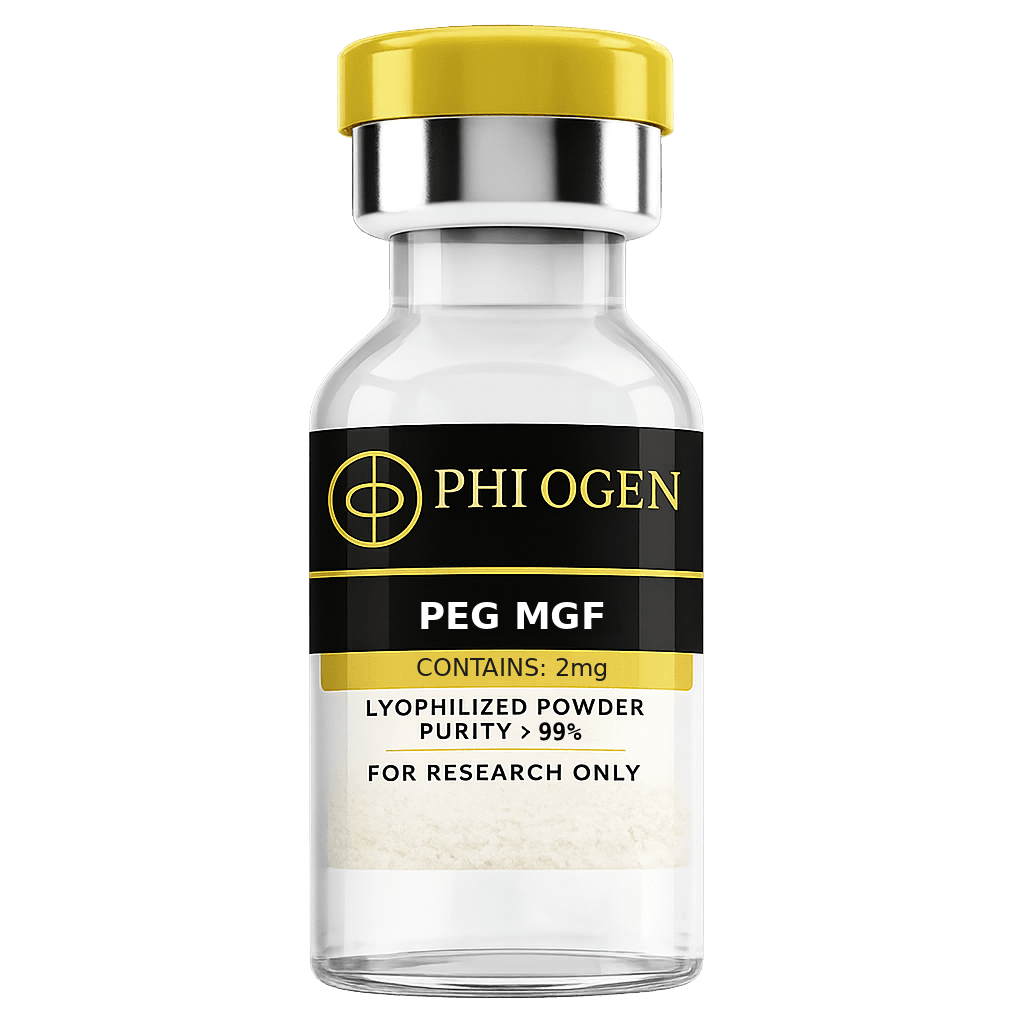
PEG-MGF 2mg
Long-Acting Mechano Growth Factor for Muscle Repair Research
PEG-MGF (Pegylated Mechano Growth Factor) is the PEGylated form of MGF, an IGF-1 splice variant that activates satellite cells at injury sites. PEGylation extends its half-life from minutes to hours for sustained muscle repair activation.
Long-Acting Mechano Growth Factor for Muscle Repair Research
MGF (Mechano Growth Factor) is produced locally in muscle in response to mechanical stress or damage. PEGylation dramatically extends its half-life, enabling sustained satellite cell activation and muscle repair — making PEG-MGF essential for muscle regeneration and hypertrophy research.
As one of the most studied compounds in the growth & body comp research space, PEG-MGF has attracted sustained scientific interest across Muscle repair research, Satellite cell biology, Muscle hypertrophy studies. Peer-reviewed evidence indicates that extended half-life vs. non-PEGylated MGF, which has positioned PEG-MGF as a reference standard for researchers exploring muscle repair research outcomes. The compound's selectivity and documented tolerability in preclinical models have contributed to a rapidly growing body of literature over the past decade.
PEG-MGF Documented Benefits: 3 Documented Mechanisms
Satellite Cell Activation
Activates muscle satellite cells at injury sites to expand the myogenic progenitor pool.
Extended Half-Life
PEGylation extends half-life from ~2 minutes to several hours for sustained muscle repair activation.
Local Muscle Repair
Targets damaged muscle tissue specifically, unlike systemic IGF-1 analogues.
How PEG-MGF Works: Molecular Mechanism & Pathway
PEGylated C-terminal MGF peptide activating muscle satellite cells via IGF-1R-independent pathway to proliferate myoblasts for muscle fiber repair and hypertrophy.
The 3 primary research pathways identified for PEG-MGF — Satellite Cell Activation, Extended Half-Life, Local Muscle Repair — collectively point to a compound with pleiotropic activity across interconnected biological systems. Studies have further shown that activates satellite cells in muscle injury models, reinforcing the mechanistic picture established in earlier cell-line work. Unlike single-pathway agents, PEG-MGF's broad receptor engagement profile continues to generate hypotheses for novel applications beyond its originally characterized use cases.
Research Protocols & Compound Combinations
PEG-MGF is routinely studied alongside ACE-031 and IGF-1 LR3 in growth & body comp-focused compound panels. Researchers investigating muscle repair research have found that pairing compounds with complementary receptor profiles can produce additive results while keeping individual doses within well-characterized ranges. Preliminary evidence that distinct from systemic IGF-1 in local vs. systemic action has informed several of these multi-compound protocol designs.
Purity, Testing & Research Grade Standards
All PEG-MGF research material offered through this catalog is manufactured under controlled conditions and independently verified by a third-party laboratory prior to release. Each lot undergoes High-Performance Liquid Chromatography (HPLC) analysis to confirm ≥98% purity, with identity confirmed via mass spectrometry. The accompanying Certificate of Analysis (CoA) documents the exact purity, molecular weight confirmation, and lot-specific testing date — data that should accompany any reproducible research protocol. Lyophilized powder formulation ensures maximum stability during shipping and storage at −20°C long-term or 4°C for short-term use.
◈ Key Highlights
- Extended half-life vs. non-PEGylated MGF
- Activates satellite cells in muscle injury models
- Distinct from systemic IGF-1 in local vs. systemic action
Ideal For
- Muscle repair research
- Satellite cell biology
- Muscle hypertrophy studies
- Regenerative medicine research
Intended for laboratory use only. Not for human or animal consumption. Not FDA approved. Handle in appropriate lab settings only.
What the Research Shows
The following data points are derived from peer-reviewed preclinical and clinical studies on PEG-MGF. All studies cited in compound profiles are indexed in PubMed or published in peer-reviewed journals.
Extended half-life vs. non-PEGylated MGF
Activates satellite cells in muscle injury models
Distinct from systemic IGF-1 in local vs. systemic action
Third-Party Verified Every Batch
Each vial of PEG-MGF is independently tested by a third-party laboratory before fulfillment. You receive the actual CoA (Certificate of Analysis) documentation with your order.